VP development, BC residential developer
“We had a DCC payment that was the wrong amount. The correct number was in a schedule on the municipal website. Application came back. Six weeks lost.”
Data and AI consulting, rooted in over 21 years of data.
Enterprise solutions for organizations of every size.
PX Labs / IQ Suite
AI permit intelligence
Pre-screens permit applications against bylaws, OCP and design guidelines before submission. Serves developers and municipalities.
At a glance
The overview
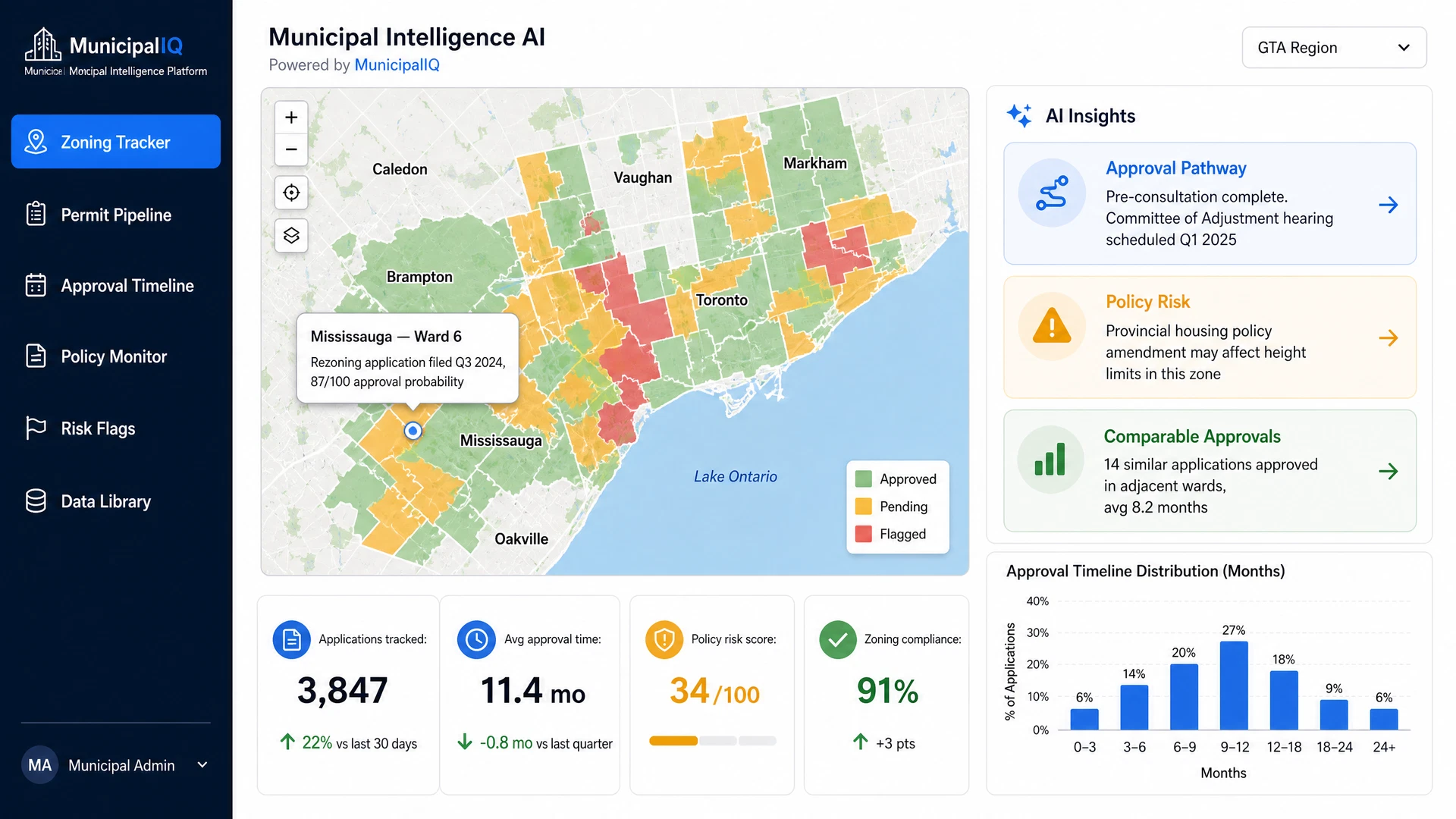
MunicipalIQ is a Snowflake-native AI application designed to pre-screen development permit applications against bylaws, Official Community Plans (OCPs), and design guidelines before submission to a municipality, helping prevent deficiency returns. It is BC-centric and serves both developers and municipalities. Its regulatory corpus is 100% indexed, and the municipality pilot is a four-week deployment.
IQ Suite
Permit applications can fail for reasons already stated in a bylaw. A return for deficiencies can add 4-8 weeks to a development timeline and consume staff time on both sides, even where the deficiency was preventable.
Zoning bylaws, OCPs, design guidelines, and building codes run to hundreds of pages. Developers cannot readily read every requirement for every application, and municipal staff face the same breadth of material under review deadlines. Planning departments spend significant time on structurally non-compliant submissions that earlier screening could flag.
For a developer considering a land decision, determining whether six-storey mixed-use development is permitted on a particular parcel can require a planner, a bylaw review, and a week, when an answer is needed in an afternoon.
IQ Suite
“We had a DCC payment that was the wrong amount. The correct number was in a schedule on the municipal website. Application came back. Six weeks lost.”
“We'd love to reduce our deficiency rate. But we don't have the staff to pre-screen every application before it comes in.”
IQ Suite
MunicipalIQ is intended to ingest the regulatory document corpus and screen permit application documents before submission, surfacing compliance gaps, missing requirements, and design guideline conflicts before they become reasons for rejection.
Zoning bylaws, Official Community Plans, design guidelines, application requirements, and building codes are ingested, chunked, and indexed for AI review.
Application documents are screened against the regulatory corpus; conflicts, missing requirements, and non-compliant elements are flagged with specific bylaw references and remediation guidance.
A question such as “Can I build 6 storeys on this parcel under the OCP?” receives a plain-English answer with relevant bylaw provisions cited. The intended benefit is to answer in seconds or an afternoon rather than waiting a week.
Developers use pre-submission screening; municipalities use the application to reduce the review burden associated with structurally non-compliant applications.
Aggregate submission data, deficiency patterns, and common non-compliance issues are stored in Snowflake so planning departments can see where developers consistently struggle.
The application deploys within the client's Snowflake environment, keeping regulatory documents inside its data perimeter and making submission analytics available for AI and BI analysis in the same governed layer.
IQ Suite
Developer pilots run at a standard pace. Municipality pilots account for procurement timelines, with active scoping counted as forward progress.
Regulatory document ingestion; OCR for scanned bylaws; semantic chunking and vector embedding; and retrieval-index construction and validation.
Application screening logic, bylaw cross-reference, deficiency identification, remediation guidance output, and a Streamlit review interface.
Planning Q&A with bylaw citation, developer-facing and municipality staff interfaces, and a source citation standard on every answer.
Submission trend analytics in Snowflake, deficiency pattern analysis, a planning department dashboard, and corpus update management.
Pricing and packaging are to be confirmed with the first municipality and developer clients based on pilot learnings.
Extend corpus coverage to additional BC municipalities and eventually other provinces.
IQ Suite
Screen applications against the regulatory corpus before municipal review so deficiencies found in pre-screening do not become six-week rejections.
Ask questions such as “What are the setback requirements for this zone?” without waiting for a planning department phone call, supporting faster land decisions.
Fewer structurally deficient applications would let municipal planning staff shift time from preventable deficiencies to processing complete, compliant submissions.
Aggregate deficiency patterns, common non-compliance issues, and application volume trends in Snowflake to help planning managers improve processes and guide developer education.
Support developers with pre-submission screening and municipalities with review efficiency.
IQ Suite
Pre-screening is intended to catch a missed schedule reference, an incorrect development cost charge (DCC), or a non-compliant building height before rejection.
Use zoning, setback, and floor space ratio (FSR) questions to assess site feasibility without waiting for planner callbacks.
The goal is for pre-screened applications to be structurally sound, leaving municipal staff to focus on judgment calls rather than structural non-compliance.
Automatically check the indexed corpus against applications rather than manually cross-referencing bylaws and design guidelines for each submission.
Store submissions, screenings, and deficiencies in Snowflake to support planning analytics across submission history.
IQ Suite
Finding deficiencies before submission is intended to produce more complete applications that move faster through the queue.
Natural-language Q&A across the regulatory corpus helps development teams assess whether a site is viable in hours rather than waiting a week to reach a planner.
Fewer structurally non-compliant applications entering the queue would shift planning staff time from deficiency notices to substantive review.
Store aggregate submission patterns, common deficiency types, and the bylaw provisions most frequently triggered in Snowflake for planning analysis.
Planning consultants can pre-screen client applications and answer planning questions faster, differentiating their service without adding staff.
MunicipalIQ is the only AI application built specifically for BC's permitting process, addressing a recurring development pain point.
IQ Suite
The solution is built on open, well-supported tools that a client team can own, extend, and audit, without proprietary black boxes.
Deploys within the client's Snowflake environment; regulatory documents and submission data remain inside its data perimeter.
Models are optimised for regulatory document comprehension and compliance-gap identification and tuned for BC bylaw and OCP document structures.
Grounds answers in the regulatory corpus, with source citations identifying the bylaw section and page on every output.
Supports text and scanned PDFs, HTML bylaws, and structured application requirements, with automatic OCR for scanned bylaw documents.
Browser-based interfaces support developer pre-submission screening and municipality review. No training is required.
The regulatory corpus is versioned and managed so bylaw amendments and OCP updates can be applied to the index without full re-ingestion.
Submission history, screening results, deficiency patterns, and planning analytics are stored in governed Snowflake tables for BI and AI analysis.
Each screening output includes a bylaw reference, page citation, and remediation guidance; no compliance flag is issued without a cited source.
Runs in a Snowflake environment hosted on AWS, Microsoft Azure, or Google Cloud, on the cloud hosting the client's Snowflake tenant, with no infrastructure changes required.
IQ Suite
Pre-screen applications for deficiencies that could cost six weeks and use planning Q&A to assess site feasibility in hours rather than waiting for callbacks.
Reduce structurally deficient submissions so staff can focus review time on substantive judgment calls rather than preventable compliance issues.
Use MunicipalIQ with clients to pre-screen applications, answer planning questions faster, and differentiate services without adding headcount.
Use the BC-centric product's unique focus on this permitting problem to open a planning and development workflow vertical.
IQ Suite
Developer pilot: a three-week fixed engagement. Municipality pilot: a four-week system deployment, with procurement timelines taken into account during scoping.
Tell us about your permit intelligence needs. Pricing and packaging are in progress and are to be confirmed through pilot learnings.
Start a conversation